
The Vibe Coding Trap
It's not possible to create serious software without knowing how to code.

This week, I joined Ed Zitron on Better Offline to talk about this topic. Listen to the episode here.
What is Vibe Coding
Andrej Karpathy coined the term “vibe coding” in 2025 with this tweet:
“There’s a new kind of coding I call “vibe coding”, where you fully give in to the vibes, embrace exponentials, and forget that the code even exists... Sometimes the LLMs can’t fix a bug so I just work around it or ask for random changes until it goes away. It’s not too bad for throwaway weekend projects, but still quite amusing. I’m building a project or webapp, but it’s not really coding - I just see stuff, say stuff, run stuff, and copy paste stuff, and it mostly works.”
Karpathy’s point was that LLMs had gotten good enough at coding that they could, importantly, create throwaway weekend projects. That is, for toy projects, vibe coding is effective.
However, the definition I’m interested in is different: there is a popular promise that people with no coding experience can create a fully functional and valuable piece of software using LLM-based tools.
There are a number of companies providing these services, and I contend that they are selling a false promise to their customers. It is not possible with today’s technology to create serious software without knowing how to code.
The Vibe Coding Trap
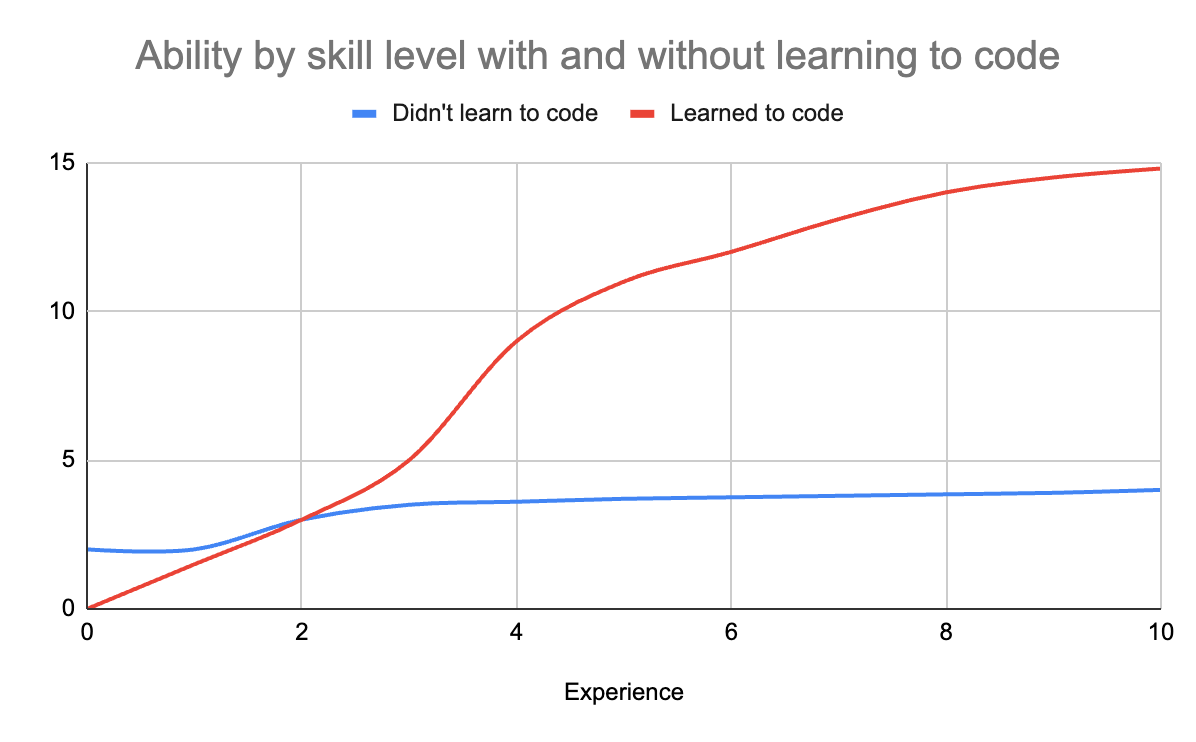
Above is an illustration of why vibe coding is so alluring. For someone with zero experience, and no intention of learning to code in a traditional fashion, they will demonstrate greater ability in creating software at the start of their journey.
This area of the curve is the “vibe coding trap”, where the person creating software with LLMs is more productive than their peers spending time learning the fundamentals. The trap is that the pure vibe coder gains very little in terms of ability over time as they do not understand what they are doing. Through trial and error they gain some skills, but not nearly as much as the traditional learner.
Vibe Code Happens to You
This newsletter is called “Code Doesn’t Happen to You”, and this is true, as long as you’re the one writing it. While vibe coding, you type instructions into a prompt, press the “give me the code” button, and digital dice are rolled until you have your answer. You have little or no control as a vibe coder as to what comes out, and you exercise little to no agency. The generated code Happens to You.
Whether coding traditionally or with an AI, if Code Happens to You, it is almost impossible to make progress on anything other than the simplest programs. Every bug you fix causes another, and you don’t know why. Adding a new feature breaks an old one, and eventually progress slows to a complete halt.
As Karpathy originally said, vibe coding is appropriate for throwaway projects, novelties that are simple to make and aren’t intended for production. If this is what vibe coding companies promised, there would be no issue. But they promise more than that. Replit, a popular vibe coding company, says “Turn your ideas into apps. What will you create? The possibilities are endless.” Note their marketing does not say “turn your ideas into throwaway weekend projects”. That wouldn’t sell subscriptions.
The possibilities for what vibe coders can create is not endless. The potential frustration they feel may be, however. In time, the curve I drew above will become clear, and people interested in software will have to return to learning the fundamentals before starting to build. When they do, they will be more productive, have more agency, be less frustrated, and may even have fun.